

What if the biggest hurdle to your new Dubai home wasn’t finding the right view, but surviving the first 48 hours of payments? Between the standard 5% to 10% security deposit and that heavy first rent cheque, your bank account takes a massive hit before you even unpack a single box. Understanding the nuances of a security deposit vs rent payment is no longer just about knowing where your money goes. It’s about reclaiming your financial liquidity in a market that traditionally demands everything upfront. You’ve likely felt the stress of watching your savings vanish into a landlord’s hands while worrying about unfair deductions later.
We’re here to change that narrative and empower your move. You’ll master the legal differences between these costs and learn how to safeguard your deposit using the latest 2026 regulations. This guide explores how modern fintech is finally breaking the cycle of massive upfront payments. We’ll dive into strategies that keep more cash in your pocket, from digital payment rewards to flexible monthly installments that treat your rent like a lifestyle investment rather than a financial burden. It’s time to move with confidence and keep your cash flow moving with you.
Key Takeaways
- Master the financial difference between your security deposit vs rent payment to protect your savings. One is a refundable safety net, while the other is the fixed cost of your lifestyle.
- Bridge the cash flow gap by splitting your annual rent into manageable monthly installments. Keep your liquidity intact instead of draining your bank account on move-in day.
- Say goodbye to physical cheques and embrace a 100% digital, Sharia-compliant rental experience. Simplify your life with AI-powered tracking and fast approvals.
- Turn your largest monthly expense into a value-driven investment. Earn rewards through the BELONG program every time you pay your rent digitally.
- Understand your rights under Ejari-compatible agreements to ensure your deposit remains protected. Learn the legal framework that helps prevent unfair deductions at the end of your lease.
Security Deposit vs Rent Payment: Defining the Entry Costs
Moving into a new home in Dubai is a milestone. It’s also a significant financial event. The primary challenge for most tenants is the simultaneous demand for a security deposit vs rent payment. Traditionally, the UAE rental market has functioned on a high-trust, high-upfront model. Landlords require these funds to mitigate risk and guarantee income. Understanding where your money goes is the first step toward managing your cash flow effectively. It’s your move, and we’re here to make it smarter.
It’s vital to distinguish between these two costs early in the process. A rent payment is the non-refundable price you pay for the space you occupy. A security deposit is a refundable sum held as insurance. You might also encounter a “holding deposit” during your search. This is a smaller, temporary fee used to reserve a property while the contract is drafted. Once the lease is signed, this holding fee usually converts into part of your security deposit. Knowing these differences prevents confusion during the high-speed negotiation phase of a Dubai move.
What is a Security Deposit in the UAE?
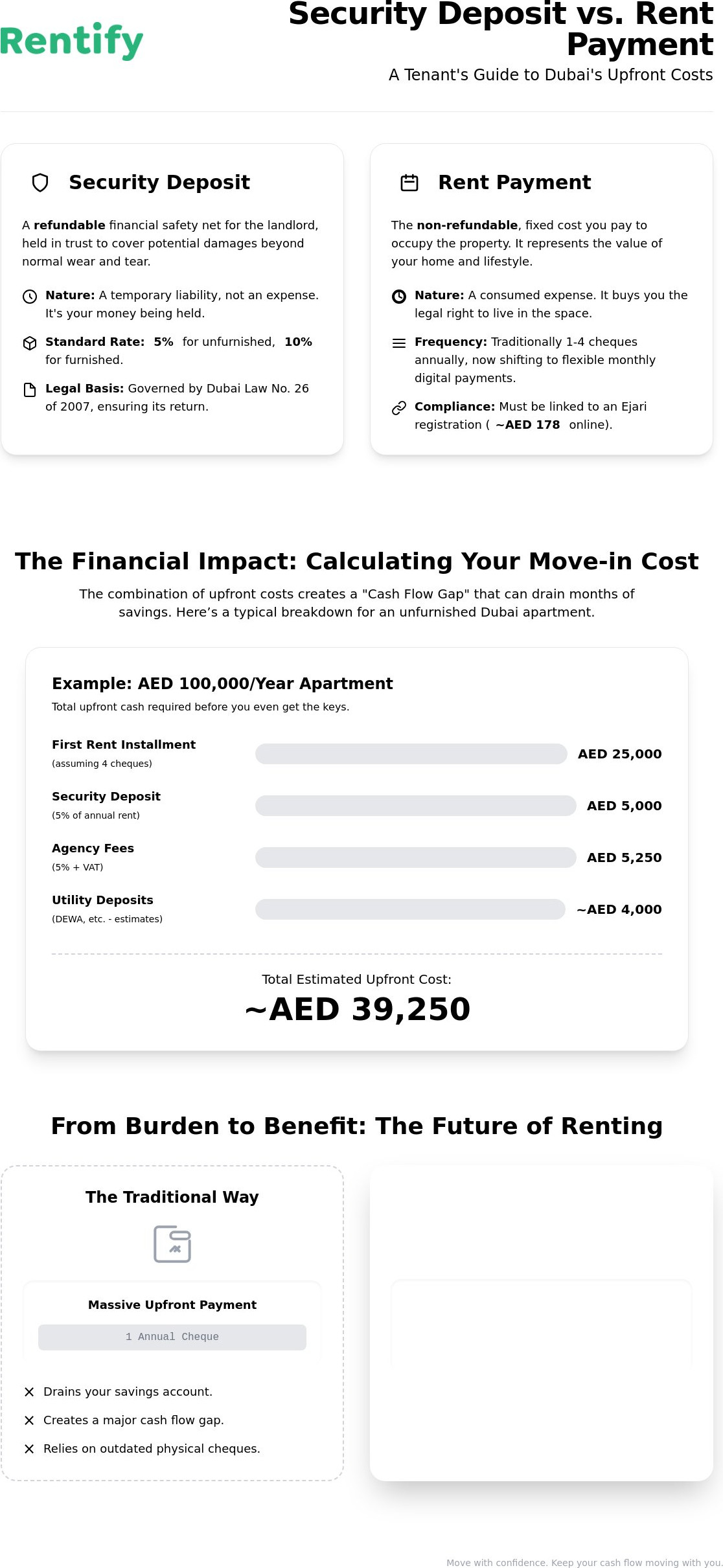
Think of the security deposit as a financial safety net for the landlord. It exists to cover potential damages that exceed normal wear and tear or any outstanding utility bills left at the end of the tenancy. In the Dubai market, the standard rate is 5% of the annual rent for unfurnished properties and 10% for furnished ones. While it feels like a loss when you hand over the cheque, it’s technically a temporary liability. It’s your money, held in trust. It shouldn’t be viewed as an expense, but as a held asset on your personal balance sheet.
Legally, the definition of what is a security deposit is governed by Dubai Law No. 26 of 2007. This law requires landlords to refund the full amount at the end of the lease unless they provide evidence of necessary repairs. To protect your cash, always document the property’s condition on day one. High-resolution photos and a detailed check-in report are your best defense against unfair deductions later. Transparency is the foundation of a stress-free move.
Understanding Your Rent Payment Obligations
The landscape of rent payments is changing fast. We’re witnessing a transition from the old-school system of one or two annual cheques to a more flexible, digital installment model. Your rent is a consumed expense. It represents the value of the roof over your head. Unlike the deposit, this money is gone once paid, but it buys you legal protection and a place to call home. It’s the cost of your lifestyle, while the deposit is the cost of your security.
Compliance is non-negotiable. Every rent payment must be linked to an Ejari registration. This mandatory system ensures your contract is recognized by the Dubai Land Department. The cost for online registration is currently AED 177.75. If you prefer to visit a Real Estate Services Trustee Centre, the fee is approximately AED 220. These small administrative costs are the tenant’s responsibility unless your contract states otherwise. They provide the legal foundation that turns a simple payment into a protected right of occupancy.
The Financial Impact: Calculating Your Total Move-in Cost
Calculating the entry price for a new apartment in Dubai isn’t as simple as looking at the monthly rate. You’re facing a massive aggregation of costs. Most tenants find themselves balancing the security deposit vs rent payment alongside agency fees and utility activations. This concentration of expenses creates a “Cash Flow Gap” that can drain months of savings in a single afternoon. It’s a significant financial hurdle that traditional systems often ignore, leaving tenants to navigate a liquidity crisis on their own.
When you stack these requirements, the total move-in tally usually includes:
- Agency Fees: Typically 5% of the annual rent plus VAT.
- Security Deposit: 5% (unfurnished) or 10% (furnished).
- First Rent Installment: Anywhere from 25% to 100% of the annual total.
- Utility Deposits: Mandatory fees for DEWA and district cooling.
The 5% vs 10% Rule: What to Budget For
Standard market practice in Dubai dictates a 5% deposit for unfurnished units and 10% for furnished ones. Furnished units carry higher financial risk because you’re responsible for everything from the designer sofa to the smart appliances. Beyond the deposit, don’t forget the “hidden” essentials. Utility activation and cooling deposits are mandatory liquidity drains that happen before you even move your first box. These costs are often overlooked during the initial search, but they’re non-negotiable for getting the lights on. For a comprehensive breakdown of every expense you should anticipate, the hidden costs of renting in UAE guide provides a full 2026 checklist to help you budget accurately from day one.
Single Cheque vs. Split Payment Realities
Historically, Dubai landlords preferred the security of a single annual cheque. While this offers them peace of mind, it forces tenants into a defensive financial position. Paying a massive portion of your annual rent upfront, plus a deposit, is a heavy lift. Splitting these payments into monthly installments preserves your monthly liquidity and supports overall financial wellness. It allows you to keep your capital working for you instead of sitting idle in a landlord’s bank account. The benefits of monthly rent go far beyond simple budgeting, representing a fundamental shift in how tenants build wealth and maintain liquidity in the Emirates. You can explore flexible payment options that align with your modern lifestyle.
The traditional cheque-based system creates artificial financial barriers. It limits your housing choices based on your current cash-on-hand rather than your actual income. Every dirham locked in a security deposit is a dirham not earning for you. Modern fintech changes the math. By moving toward digital, installment-based workflows, you reclaim control over your largest expense. You remove the friction of legacy processes and gain the transparency you deserve in a fast-paced market.
Liability vs Expense: A Tenant Comparison Framework
Managing your bank account during a move requires a clear mental shift. You need to view your housing costs through two distinct lenses: the consumed expense and the restricted asset. Your rent is an expense. It’s the price of the roof over your head, and once paid, that capital is gone. Your security deposit is a liability for the landlord and a held asset for you. Understanding the security deposit vs rent payment dynamic helps you categorize your cash flow accurately. One buys you time in a property; the other buys the landlord peace of mind.
Legal protections in the UAE are designed to safeguard both buckets of money. Ejari-compatible agreements serve as the ultimate shield. These contracts clearly state the terms for both payments, ensuring your rights are enforceable. If a landlord withholds your deposit without valid evidence, the Rental Dispute Settlement Centre (RDSC) provides a structured path for recovery. Conversely, late rent payments carry different risks, including potential eviction under Law No. 26 of 2007. The stakes are high for both, but the legal remedies vary significantly. Modern tenants are moving away from seeing rent as “dead money.” By utilizing digital platforms, you can transform these massive transactions into rewarding experiences through loyalty programs like BELONG.
Normal Wear and Tear vs. Actual Damage
The biggest point of friction in the security deposit vs rent payment conversation is the “wear and tear” clause. Dubai Law No. 26 of 2007 stipulates that landlords must return the deposit unless damages exceed normal usage. Normal wear and tear includes minor scuffs on floors or slightly faded paint. Actual damage involves broken fixtures, holes in walls, or deep stains. Your best defense is a proactive documentation strategy. Take timestamped photos and high-definition videos on move-in day. Share these with your landlord immediately to establish a baseline. A clear, documented starting point prevents expensive disputes before they even begin.
The Opportunity Cost of Your Security Deposit
Every dirham locked in a security deposit is a dirham not working for you. If your annual rent is AED 150,000, a 5% deposit means AED 7,500 is sitting idle for at least twelve months. In a high-yield savings account or a diversified portfolio, that capital could be generating returns. This is the opportunity cost of traditional renting. Modern UAE tenants are increasingly prioritizing liquidity. Managing your cash flow isn’t just about paying the bills; it’s about keeping your capital accessible. By choosing split-cost options or installment-based rent, you avoid the heavy upfront drain. You keep your savings intact and your financial flexibility high, allowing you to invest in your lifestyle rather than just securing a landlord’s asset.
Modernising the Workflow: Digital Payments and Ejari Compliance
The era of the post-dated cheque is fading. Dubai’s rental market is embracing a 100% digital experience that replaces manual friction with systemic efficiency. This shift fundamentally changes how you handle the security deposit vs rent payment balance. It moves the conversation away from paper ledgers and toward real-time transparency. By digitizing the workflow, both parties gain a clear, immutable record of every transaction made. It’s a move toward a more fluid, digital future where speed is the new standard.
AI-powered dashboards now act as a sophisticated innovator for your rental management. These platforms provide a single source of truth where both landlords and tenants can track payment histories and upcoming obligations without the risk of lost paperwork. This transparency is vital for maintaining trust. With approval times now compressed into a 24 to 48-hour window, the speed of modern renting finally matches the pace of Dubai itself. You’re no longer waiting days for a landlord to manually clear a cheque or acknowledge a deposit. You can get started with digital rent payments today and experience the speed of a truly modern platform.
Chequeless Renting: The New Standard
Paying your rent should be as simple as buying a coffee. Modern platforms allow you to utilize credit cards, Apple Pay, or digital wallets to settle your dues. This isn’t just about convenience; it’s about security. Digital transactions create an automated, trackable trail that physical cheques simply can’t match. This digital breadcrumb carries immense value when the lease ends. If there’s a question about your initial payment, the evidence is right there in your app. A clear digital trail simplifies the eventual return of your security deposit by removing any ambiguity about what was paid and when.
Sharia-Compliant Financing in the Rental Market
Modern UAE proptech operates on an ethical framework that respects regional values. Sharia-compliant models ensure that the financial relationship between landlord and tenant is transparent, fair, and free from traditional interest-based friction. This matters because it fosters a sense of community and professional reliability. Infrastructure layers now connect banks, landlords, and renters in a way that was previously impossible. These systems ensure that every agreement is Ejari-compatible and legally sound. It’s about building a visionary guide for the future of housing, where ethical finance and tech-forward solutions meet to protect your cash flow.
Optimising Your Cash Flow with Rentify RNPL
The tension between a security deposit vs rent payment usually hits hardest on move-in day. Rentify’s Rent Now, Pay Later (RNPL) solution dissolves this friction. We bridge the gap between legacy property demands and your modern financial reality. Our platform ensures your landlord receives the full annual rent upfront, while you enjoy the freedom of 12 manageable monthly installments. It’s a 100% digital, Sharia-compliant experience designed for the sophisticated resident who values systemic improvement over outdated habits.
Speed defines our process. The onboarding is entirely paperless and happens within our secure digital ecosystem. You can secure approval in as little as 24 to 48 hours. This efficiency means your move stays on track without the stress of manual cheque writing or bank visits. Our AI-Powered Landlord Dashboard works in the background to sync these payments, providing transparency for both parties. You keep your liquidity. You keep your peace of mind.
Splitting Your Rent mid-Tenancy
Flexibility shouldn’t end when you sign the lease. Rentify allows you to manage your cash flow whenever your circumstances shift. RNPL addresses the fundamental friction of the security deposit vs rent payment by decoupling the landlord’s need for security from your need for monthly budgeting. Analysis shows that 81% of UAE tenants prefer monthly payment options over large, lump-sum cheques. Our platform meets this demand by providing automated schedules that keep your rental history spotless and your credit score healthy. Whether you’re moving in or already settled, you can transition to a payment plan that respects your budget.
BELONG: Earning Rewards on Every Dirham
Your rent is your largest monthly expense. It should also be your most rewarding. Through the Rentify Rewards Program, BELONG, every dirham you spend earns you a coin. It’s a simple 1:1 ratio. These coins aren’t just numbers on a screen. They are your ticket to premium lifestyle experiences across the UAE. From luxury dining to exclusive wellness retreats, your rental history becomes a powerful financial asset. Many residents are already curious if rent rewards exist in the UAE, and the answer is a resounding yes. It’s time to stop paying “dead money” and start earning value on every payment. This is the future of the rental ecosystem, where your reliability is recognized and rewarded with every digital transaction.
Take Command of Your Rental Future
The historical friction of balancing a security deposit vs rent payment is finally a relic of the past. You now have the sophisticated tools to treat your housing costs as a strategic investment rather than a liquidity drain. By prioritizing digital, Ejari-compatible workflows, you ensure your legal rights are protected while keeping your cash flow accessible for the things that matter most. Renting in the UAE no longer requires sacrificing your entire bank balance for the sake of a legacy cheque-based system. It’s about moving with confidence and effortless efficiency.
As the Finance Middle East Startup of the Year 2025, Rentify provides a 100% Sharia-compliant model that puts the tenant first. Every digital payment you make through our platform helps you earn BELONG coins, turning your largest monthly expense into rewards you can actually use. You deserve a rental experience that is as fluid and tech-forward as the city you live in. Stop letting traditional barriers dictate your lifestyle and start building a rewarding financial history today.
Start paying rent on your own terms with Rentify and reclaim your financial freedom. Your next move is waiting; make it your smartest one yet.
Frequently Asked Questions
Is a security deposit mandatory in the UAE?
Security deposits are a standard market practice in the UAE rather than a strict legal mandate. While Law No. 26 of 2007 regulates how they are handled, landlords almost always require one to protect against potential damages or unpaid bills. It’s a fundamental part of the security deposit vs rent payment structure that defines your initial move-in costs in Dubai.
Can I use my security deposit to pay the last month of rent?
You cannot use your security deposit to cover the final month of rent without explicit written consent from your landlord. The deposit is legally intended as a safety net for property damages or outstanding utility bills. Attempting to use it for rent could lead to legal friction or a negative impact on your rental history at the end of your lease.
What is the legal limit for a security deposit in the UAE?
There is no strict legal cap on security deposits in the UAE, but market standards are firmly established. You should expect to pay 5% of the annual rent for an unfurnished property and 10% for furnished units. These rates are widely accepted by the Real Estate Regulatory Agency (RERA) as standard practice for residential tenancies.
How long does a landlord have to return the security deposit?
Landlords are required to refund the security deposit at the end of the tenancy contract. This typically happens during the final handover once utility clearances and damage inspections are complete. Any delays beyond a reasonable period can be flagged to the Dubai Land Department for intervention and resolution.
What happens if my landlord refuses to return my deposit?
You should file a formal case with the Rental Dispute Settlement Centre (RDSC) if your landlord unfairly withholds your funds. The filing fee is currently 3.5% of the annual rent. Having timestamped photos and a signed check-in report from your move-in date is critical evidence for proving the property’s condition and winning your case.
Can I pay my security deposit and rent via credit card?
Yes, you can pay both your security deposit and rent via credit card through digital platforms like Rentify. This modern approach replaces the need for physical cheques and allows you to manage your cash flow more effectively. It also provides an immutable digital trail of every transaction for your financial records.
Is Rent Now, Pay Later (RNPL) legally compliant with Ejari?
Rent Now, Pay Later (RNPL) is fully compatible with Ejari registration and UAE rental laws. While the landlord receives the full annual amount upfront, your contract is registered as usual with the Dubai Land Department. This ensures you maintain all your legal rights as a tenant while enjoying the flexibility of monthly payments.
Do I earn rewards on my security deposit or only on rent payments?
You earn BELONG coins exclusively on your rent payments, as these are the consumed expenses of your tenancy. Since the security deposit is a refundable asset held in trust, it doesn’t qualify for the 1:1 reward earn rate. Every dirham of rent you pay digitally brings you closer to premium lifestyle experiences across the UAE.